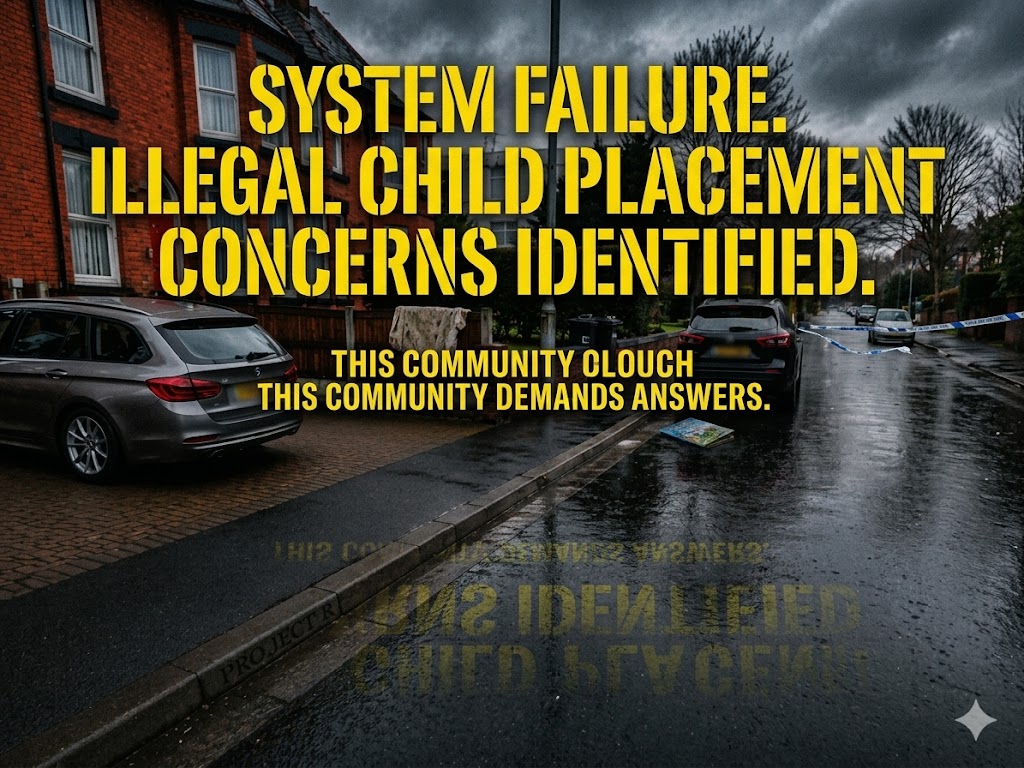
This is not a single placement concern. What sits behind this investigation is a system operating outside its own legal framework, and the evidence now shows that clearly.
Project R’s Care-Experienced Reviewing Unit has completed a forensic intelligence and legal review into a current placement on Old Thomas Lane, Broadgreen, Liverpool. The legal question is simple.
If a child is being accommodated in a setting that provides both care and accommodation, is that setting lawfully registered?
If it is not, then the operation is unlawful. There is no grey area in that.
The location itself is not neutral. Verified public records confirm that the premises carries a care-related operational footprint, including classification as a “caring premises” linked to a provider now operating within a major national care group structure.
That distinction matters.
The law does not regulate what a setting calls itself. It regulates what it does. If care and accommodation are both being provided, the setting meets the legal definition of a children’s home. Registration is not optional.
Project R has verified that the child linked to this placement is 13 years old. That is the point where this moves from concern to legal certainty. Since September 2021, it has been unlawful to place a child under 16 in unregulated accommodation.
There is no alternative framework.
No workaround.
No interpretation.
A child of this age must be placed in foster care or a registered children’s home.
Project R has further verified that this 13-year-old has been out of education since February. That raises immediate safeguarding questions that cannot be avoided.
Who, on paper, is accounting for where this child is?
Where is the recorded evidence of welfare oversight, location verification, and ongoing monitoring of this child’s wellbeing?
Who is evidencing that safeguarding responsibilities are being actively discharged?
If a provision is not registered, not inspected, and not transparently recorded within the regulatory system, then there is no external oversight. That leads directly to the next issue.
What does that mean for staffing?
Where are the background checks?
Where is the evidence of training, qualifications, and safeguarding competence?
Who has assessed the individuals responsible for this child’s care?
There is no education attendance. That removes another safeguarding layer entirely.
No teacher.
No safeguarding lead.
No attendance monitoring.
No consistent professional visibility.
No structured insight into this child’s daily life, development, or risk profile.
The absence of education is not a neutral gap. It has immediate and long-term consequences. A child out of education is cut off from structured development, peer interaction, safeguarding observation, and progression pathways. Educational absence at this stage directly impacts literacy, cognitive development, emotional regulation, and future life outcomes. It increases the risk of exploitation, criminal involvement, and long-term dependency. It removes one of the most critical protective environments a child has.
Legally, this raises a further breach. Under section 19 of the Education Act 1996, local authorities have a duty to secure suitable full-time education for children who, for whatever reason, would not otherwise receive it. For a looked-after child, that duty is heightened through corporate parenting obligations. A child being out of education for this period is not simply a service failure. It is a failure to discharge a statutory duty.
At that point, this is no longer just a placement issue. It is a compound failure across safeguarding, education, and legal compliance.
If the premises is providing care and accommodation without registration, that is a criminal offence under the Care Standards Act 2000. That is not interpretation. That is statute.
What this case exposes, however, is not limited to one location.
National data now confirms this is happening at scale.
As of 1 September 2025, 669 looked-after children were living in illegal unregistered settings across England. The year before, that figure was 775. This is not being resolved. It is being sustained.
The cost to the public purse is £353 million per year. Individual placements exceed £10,000 per week, with some exceeding £1 million per child annually.
These are not short-term emergency placements. Children are being kept in these settings for months at a time, with an average duration of around six months.
The risk profile is significantly higher. Around 30% of children in illegal placements go missing, compared to approximately 11% across the wider care system. 61% are placed outside their local authority area, increasing isolation and reducing oversight. 89% of these placements are operated by private providers.
Regulatory activity reflects awareness, not control. Ofsted initiated hundreds of investigations, with reported cases rising from 147 in 2020–21 to 982 in 2023–24. This is rapid escalation, not containment.
Parliament has already stated the position clearly. Approximately one in ten children in residential care are now in illegal placements. The system has been described as dysfunctional, and this practice as normalised.
The National Audit Office has described the children’s residential care market as a market failure.
And still, no enforcement.
Operating an unregistered children’s home is a criminal offence. That law has been in force for 5 years. Not a single provider has been prosecuted.
So the questions now have to be asked directly.
If this is the law, why is it not being enforced?
How are local authorities continuing to place children into settings that meet the threshold of a criminal offence?
And how is it that these issues are repeatedly acknowledged at the highest levels of the judiciary, described as a scandal, examined in case law, and still allowed to continue? The courts have recognised the crisis. The system has full visibility. The law is clear. Yet the practice continues.
The reality is now unavoidable. This is not a gap in legislation. It is a failure to act on it.
The financial structure explains part of it. The maximum penalty for operating an unregistered home is £5,000.
A provider charging over £10,000 per week recovers that in less than half a day. There is no deterrent. There is no consequence.
What that means in practice is that children are being placed into environments with no guaranteed inspection, no enforced staffing standards, no independent oversight, and no consistent safeguarding framework.
For the child on Old Thomas Lane, this is immediate.
No education.
No visible regulatory framework.
Limited external visibility.
For the system, the conclusion is already clear.
Hundreds of children.
Hundreds of illegal placements.
Hundreds of millions in public funding.
Zero prosecutions.
This is not an isolated issue. This is how the system is currently operating.
Project R will now proceed with formal regulatory escalation to establish the verified status of this placement, including Ofsted registration, commissioning authority, and safeguarding oversight. Where the evidence supports it, further legal action will follow.
The law is clear.
The system is not following it.
The placing authority?