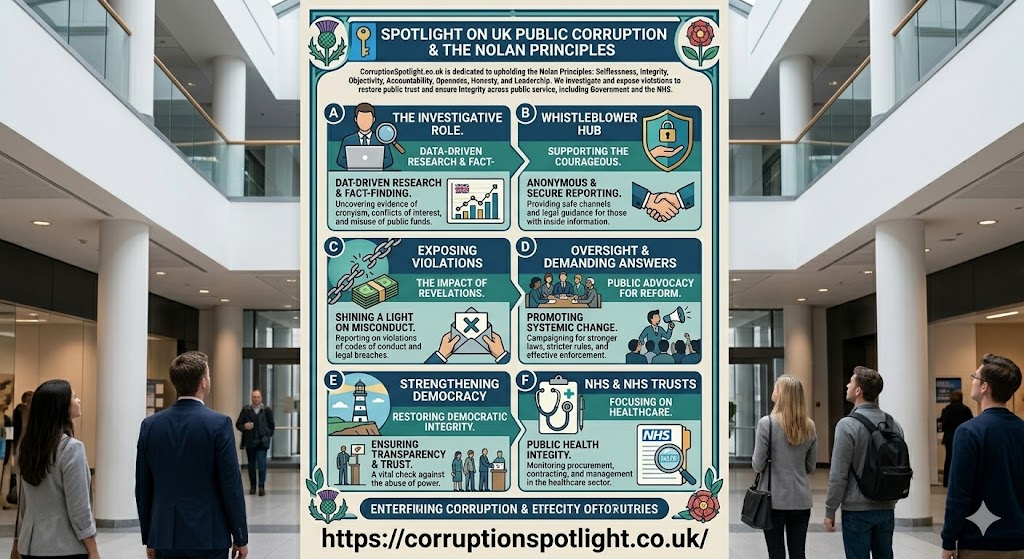
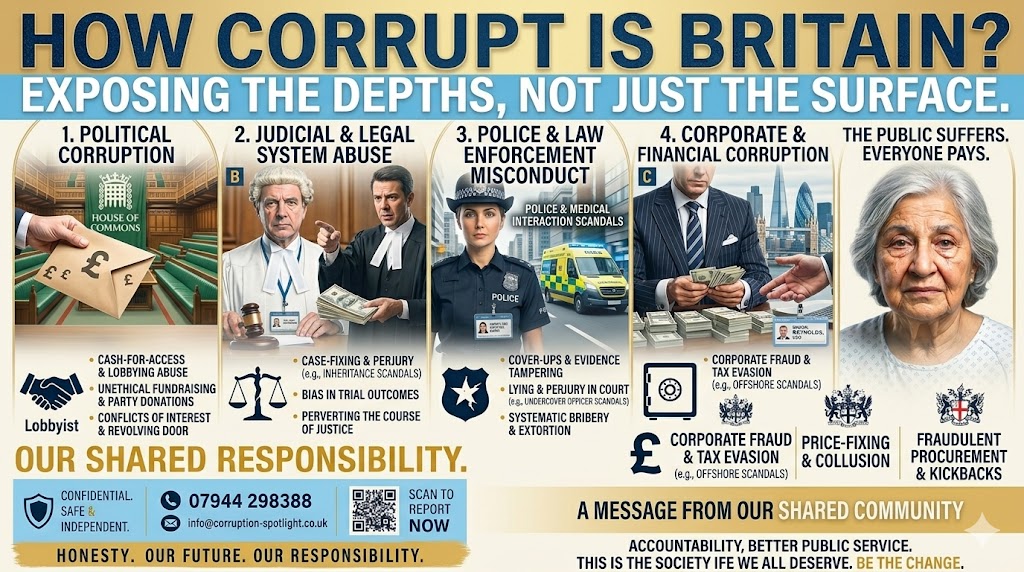
Public office corruption in the United Kingdom, while often perceived as low compared to global standards, has faced intense scrutiny due to high-profile scandals, particularly in procurement and lobbying. Transparency International and parliamentary reviews indicate that “systemic” risks exist, with the UK sometimes acting as a hub for illicit financial flows.
Below is an analysis of public office corruption in the UK based on recent cases and evaluations.
Key Case Studies and Scandals
Recent investigations have highlighted significant vulnerabilities in the UK’s public sector:
- COVID-19 Procurement “VIP Lane”: During the pandemic, the government established a “VIP lane” for suppliers with political connections, which was found to have weak conflict-of-interest management. Reviews by the National Audit Office (NAO) and Spotlight on Corruption identified failures in due diligence and transparency when awarding multi-million-pound contracts.
- Greensill Capital Saga: The lobbying activities of former Prime Minister David Cameron on behalf of Greensill Capital exposed the potential for “revolving door” interactions between the private sector and high-level government officials.
- The Owen Paterson Affair: Investigations into former MP Owen Paterson highlighted potential breaches in lobbying rules, sparking debate over the effectiveness of the parliamentary commissioner for standards and the integrity of MPs with private interests.
- Local Government Fraud (Gedling Borough Council): A 2008-2009 National Fraud Initiative (NFI) case showed a claimant securing £34,000 via fraudulent Housing Benefit claims over 11 years, aided by a lack of internal checks, resulting in a suspended prison sentence.
Key Vulnerabilities
Corruption risks in the UK are often not characterized by petty bribery, but by structural, “grand” corruption:
- Weak Conflict of Interest Management: The NAO has criticized government departments for failing to adequately document and manage conflicts of interest, especially regarding special advisers and non-executive directors.
- “Revolving Door” & Lobbying: The movement of personnel between the public sector and private firms, particularly lobbying firms, creates a high risk of influence-peddling.
- Illicit Finance & Property: The UK’s legal system and financial sectors are used by foreign officials to hide illicitly acquired wealth, which can, in turn, be used to gain influence.
- Procurement Vulnerabilities: The pressure to deliver quickly (as in COVID-19) often leads to a breakdown in standard procurement checks, increasing the potential for bribery and patronage.
Anti-Corruption Mechanisms
- Unexplained Wealth Orders (UWOs): Introduced to target illicit enrichment, these allow authorities to seize assets if their owner cannot explain how they were purchased.
- Public Sector Fraud Authority (PSFA): Established in 2022 to strengthen the government’s counter-fraud capabilities, doubling the number of specialists to detect fraud.
- The Serious Fraud Office (SFO): The primary authority for investigating top-level bribery and corruption, although its efficacy has been debated.
Impact and Public Perception
- Erosion of Trust: Research shows that when corruption information becomes public, it significantly reduces trust in government institutions, rather than promoting engagement.
- Perception Shift: The UK fell in Transparency International’s rankings from 8th (2017) to 18th (2022), reflecting growing public concern about integrity.
- High Losses: In the 2020-2022 period, over £21 billion was lost to fraud, highlighting the severe financial cost of weak control systems.
In summary, exposing corruption in the UK requires tracking high-level influence, strengthening auditing of public procurement, and regulating the revolving door between business and politics.
Contact Us
https://corruptionspotlight.co.uk/contact/
Great Websites to follow
https://corruptionspotlight.co.uk/great-websites-to-follow/
Buy Me A Coffee